Green Wheat Field with Cypress by Van Gogh
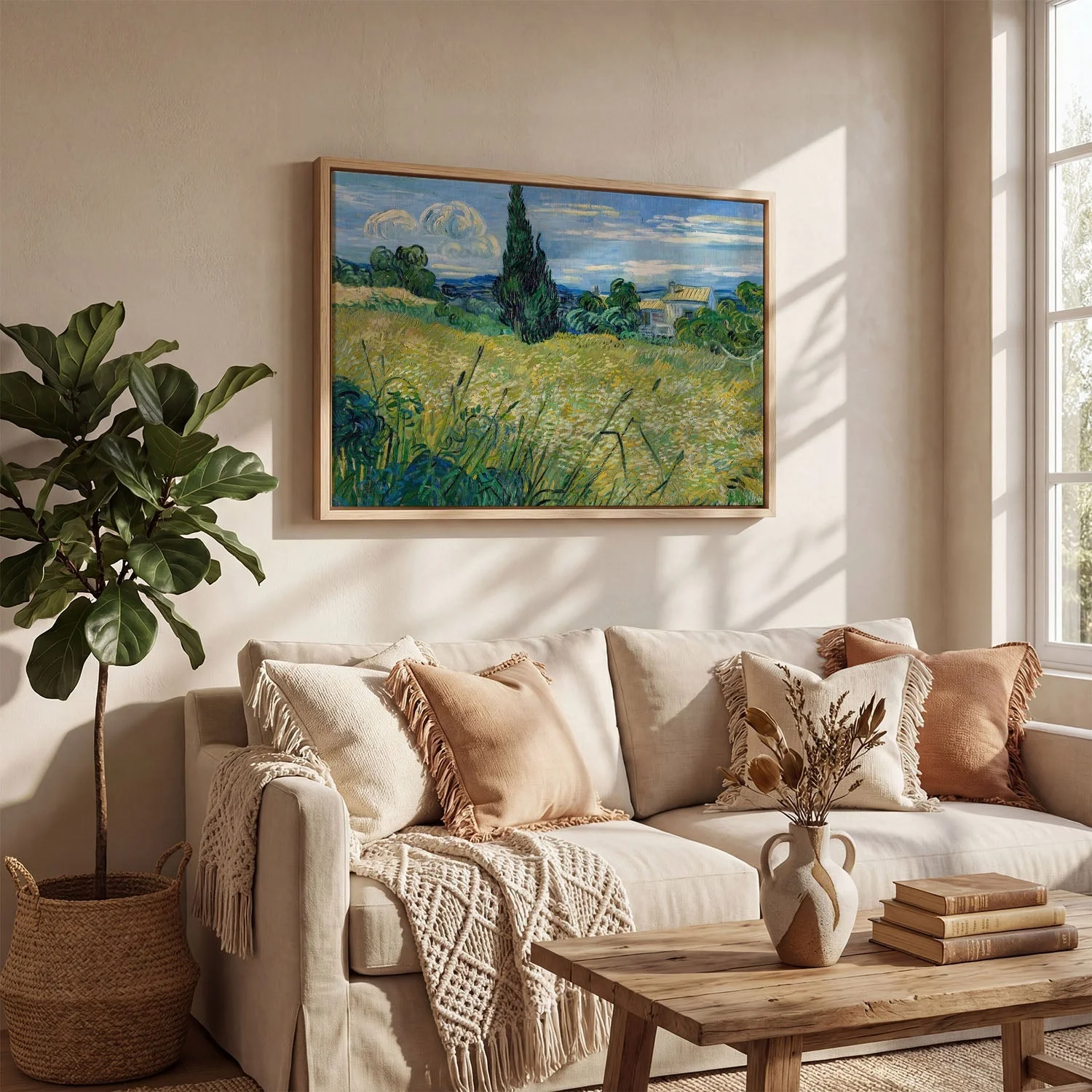
Painted in 1889 at the Saint-Paul-de-Mausole asylum, Green Wheat Field with Cypress is one of Van Gogh's most kinetic landscape compositions. A towering cypress rises at the left, its dark flame-like silhouette anchoring a scene of almost violent movement — wheat ears rippling in tight, churning strokes, the sky broken into restless bands of blue, white, and green. The palette is intense but not arbitrary: every colour serves the emotional charge of the work, a landscape felt as much as observed. The result is one of Post-Impressionism's most charged encounters between nature and inner state.
On canvas, the brushwork gains tactile presence and the colour fields deepen with a warmth that echoes the original painting's physical surface — making this canvas print a natural format for work rooted in the painted tradition.
Original: $44.15
-65%$44.15
$15.45More Images




Green Wheat Field with Cypress by Van Gogh
Painted in 1889 at the Saint-Paul-de-Mausole asylum, Green Wheat Field with Cypress is one of Van Gogh's most kinetic landscape compositions. A towering cypress rises at the left, its dark flame-like silhouette anchoring a scene of almost violent movement — wheat ears rippling in tight, churning strokes, the sky broken into restless bands of blue, white, and green. The palette is intense but not arbitrary: every colour serves the emotional charge of the work, a landscape felt as much as observed. The result is one of Post-Impressionism's most charged encounters between nature and inner state.
On canvas, the brushwork gains tactile presence and the colour fields deepen with a warmth that echoes the original painting's physical surface — making this canvas print a natural format for work rooted in the painted tradition.
Product Information
Product Information
Shipping & Returns
Shipping & Returns
Description
Painted in 1889 at the Saint-Paul-de-Mausole asylum, Green Wheat Field with Cypress is one of Van Gogh's most kinetic landscape compositions. A towering cypress rises at the left, its dark flame-like silhouette anchoring a scene of almost violent movement — wheat ears rippling in tight, churning strokes, the sky broken into restless bands of blue, white, and green. The palette is intense but not arbitrary: every colour serves the emotional charge of the work, a landscape felt as much as observed. The result is one of Post-Impressionism's most charged encounters between nature and inner state.
On canvas, the brushwork gains tactile presence and the colour fields deepen with a warmth that echoes the original painting's physical surface — making this canvas print a natural format for work rooted in the painted tradition.